
You’ve just received a notice from USCIS. Or you’re enrolling in a university abroad. Or you’re finalizing an international business contract. The instructions say you need a “certified translation,” but someone else told you it needs to be notarized. And a friend mentioned an apostille. Now you’re not sure which one applies, or whether you need all three.
This confusion is extremely common, and the stakes are real. Submitting the wrong type of certified, notarized vs apostille translation can result in a rejected application, a missed deadline, or expensive re-filings. Understanding the distinction up front saves both time and money.
This guide breaks down each document type clearly, explains exactly when each is required, and walks you through how to decide which one fits your situation, whether you’re in Oregon, Washington, or dealing with an international authority.
What Is a Certified Translation?
A certified translation is a translated document accompanied by a signed certificate from the translator or translation agency. That certificate declares, under penalty of perjury, that the translation is accurate and complete to the best of the translator’s knowledge. It includes the translator’s name, signature, date, and contact information.
Certified translation is the baseline standard for most official U.S. filings. The U.S. Citizenship and Immigration Services (USCIS) requires certified translations for every foreign-language document submitted in an immigration application, including birth certificates, marriage certificates, diplomas, police clearance letters, and more. Crucially, USCIS does not require the translator to be ATA-certified; they simply need to be “competent” in both languages.
When Do You Need a Certified Translation?
- USCIS immigration petitions (Form I-130, I-485, N-400, etc.)
- Academic transcripts and diplomas for U.S. university admissions
- Foreign court documents submitted to U.S. courts
- Social Security Administration and other federal agency submissions
- Medical records for insurance or legal proceedings
What Is a Notarized Translation?
A notarized translation takes the certified translation a step further. After a translator completes and signs the certificate of accuracy, a notary public acknowledges the translator’s signature, confirming the translator appeared before the notary and that their signature is genuine. The notary then affixes their official seal and signs the document.
Here’s what many people misunderstand: a notary public is not verifying the quality or accuracy of the translation. They’re simply verifying the identity of the person who signed the certificate. This is a legal authentication of the signature, not of the content.
When Does Notarized Translation Differ From Certified?
Notarization is an additional layer, not a replacement for certification. Some institutions require both. Others accept certification alone. When comparing certified vs notarized translation, think of it this way: certification speaks to translation quality, notarization speaks to the identity of the certifier.
Common Situations Requiring Notarization
1. U.S. State Courts & Legal Proceedings. Some state courts and probate filings in Oregon and Washington require a notarized translator’s affidavit in addition to the translation itself.
2. Banks & Financial Institutions Foreign financial records, property documents, or inheritance paperwork often require notarization when submitted to U.S. banks.
3. Adoption Proceedings. International adoptions frequently require notarized translations of foreign birth certificates, court decrees, and consent forms.
4. Some Foreign Consulates. Certain consulates require notarization of translated supporting documents when processing visa or residency applications.
What Is an Apostille Translation?
An apostille translation refers to the combination of a translated document and an apostille certificate. An apostille itself isn’t a type of translation; it’s a government-issued authentication stamp. However, when a foreign document needs to be used officially in another country, both the original document and its translation may require this authentication.
The apostille system was established by the 1961 Hague Convention. Countries that are signatories to this convention, including the U.S., most of Europe, and many nations in Latin America and Asia, agree to recognize each other’s apostille-stamped documents. As of 2024, over 120 countries are part of this agreement.
How an Apostille Works in Oregon and Washington
In the United States, apostilles are issued at the state level by the Secretary of State’s office. If you have a document issued in Oregon, say, a birth certificate, and you need it recognized in Spain or Mexico, the process works like this:
1. Obtain the original official document. This must be an official copy from the issuing authority (county clerk, vital records office, court, etc.).
2. Get a certified translation. The target country will need the document in its official language. A certified translation is typically required.
3. Submit to the Secretary of State. Send the original (not the translation) to the Oregon or Washington Secretary of State’s office for apostille processing.
4. Receive and submit the full package. The apostilled original plus the certified translation together satisfy the receiving country’s requirements.
Some countries require the translation itself to be apostilled (rather than just the original). When that’s the case, the translator may need to be a certified court translator in that country, or the translation may need to be notarized first, then apostilled. This tends to be the most complex scenario and depends entirely on the destination country’s rules.
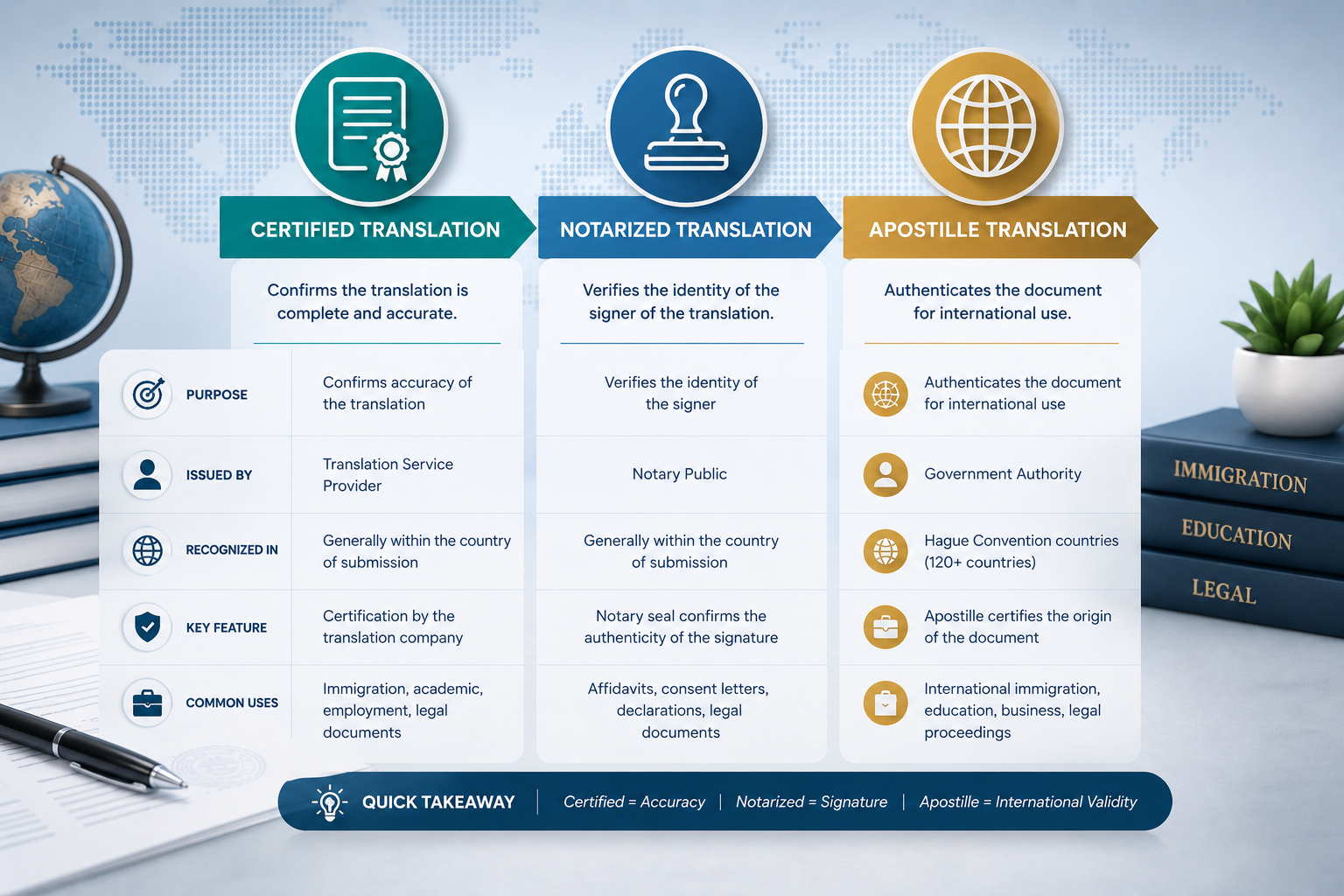
Certified vs Notarized vs Apostille Translation: Side-by-Side Comparison
The table below condenses the key differences. Bookmark this; it’s a practical reference for any document situation.
| Feature | Certified | Notarized | Apostille |
|---|---|---|---|
| What it verifies | Translation accuracy | Translator’s identity/signature | Document origin (for international use) |
| Who issues it | Professional translator | Notary public | Secretary of State (state government) |
| Required by USCIS | Yes | No | No |
| Required for international use | Often yes | Sometimes | Yes (Hague Convention countries) |
| Typical cost | $50–$150/page | Certification + $25–$50 notary fee | Varies: $10–$30 state fee + translation |
| Processing time | 24 hrs to 5 days | Same as certified + notary appointment | Days to weeks (state processing) |
| Common use case | Immigration, academic, and medical | Courts, banks, and some consulates | Foreign residency, international business, overseas education |
Quick-Reference: 3 Translation Types at a Glance
Certified Translation
- Translator’s accuracy statement
- USCIS-accepted standard
- Most common requirement
- Fastest to obtain
- Required for most U.S. filings
Notarized Translation
- Includes notary public seal
- Verifies translator identity
- Required by some courts
- Used for bank documents
- Adds 1–2 business days
Apostille Translation
- Government authentication stamp
- For international documents
- Hague Convention countries
- Issued by the Secretary of State
- Longest processing time
How to Decide Which Type of Translation You Need
The single most important thing you can do is check the specific requirements of the receiving institution before ordering. Don’t guess. Call them or check their website. That said, here’s a practical decision framework we use with our clients in Oregon and Washington:
Decision Guide: Which Translation Do You Need?
Submitting to USCIS or any U.S. federal agency? → Certified translation only.
Submitting to a U.S. state court, bank, or financial institution? → Certified + notarized translation.
Using the document in another country (Hague Convention member)? → Certified translation + apostille on the original document.
Some countries require a notarized translation apostilled. → Certified + notarized + apostille. This is the most complex path; confirm with the foreign authority first.
Enrolling in a U.S. university or college? → Certified translation in most cases; check each institution’s policy directly.
A Note on Certified vs Notarized vs Apostilled Translation Costs in Oregon and Washington
From what we’ve seen working with clients across the Pacific Northwest, the cost breakdown generally looks like this. Certified translation runs $50 to $150 per page, depending on language pair, document complexity, and turnaround. Adding notarization typically adds $25 to $50 per notarized document. Oregon’s Secretary of State charges approximately $10 per apostille certificate; Washington charges a similar flat fee per document.
Rushing the process by assuming you need the highest-tier option isn’t just unnecessary; it can slow down your filing if the requesting authority isn’t expecting notarization or apostille authentication. That’s a real risk worth avoiding.
Frequently Asked Questions
Not Sure Which Translation You Need?
Our team at Global Doc Translations has helped clients across Oregon and Washington navigate certified, notarized, and apostilled translation requirements for over a decade. We’ll match you with exactly what the requesting institution requires, nothing more, nothing less.
Final Thoughts: Match the Translation Type to the Requirement
The difference between certified, notarized, and apostilled translation isn’t just technical; it’s practical. Getting it wrong costs time, money, and potentially the outcome of an immigration case, a legal filing, or an international opportunity.
The short version: certified translation is the everyday standard. Notarized translation adds a legal layer that some institutions demand. Apostille translation is the path when your documents cross international borders under the Hague Convention. And in many cases, you’ll only need one of these, not all three.
When in doubt, always verify with the requesting institution. And when you’re ready to move forward, work with a professional translation service that understands the specific requirements of Oregon and Washington agencies, USCIS, and international authorities alike.