
Preparing for a visa interview is stressful enough without scrambling for paperwork at the last minute. One of the most overlooked steps in the entire process is deciding when to translate documents for a visa interview.
Get this timing wrong, and you could face rejection, delays, or a reschedule that sets your plans back by weeks or even months.
This guide breaks down everything you need to know about when to act, what can go wrong if you wait too long, and how to make the process as smooth as possible.
Key Takeaways
- Start the process to translate documents for a visa interview at least 4 to 6 weeks before your appointment date.
- Certified translations can take 3 to 10 business days, depending on language complexity and document volume.
- Rushed translation jobs increase the risk of errors, which consulates reject without exception.
- Always use a professional, certified translator recognized by the receiving country’s immigration authority.
How Early Should You Translate Documents for a Visa Interview?
Most immigration experts and consulate guidelines recommend that you translate documents for a visa interview no later than four to six weeks before your appointment.
That window gives you enough time to review the translations, request corrections if needed, and still have everything certified and ready well before the interview date.
It might sound like a long runway, but it fills up faster than you’d expect.
Document translation is not a same day service, especially for official submissions. Certified translators need time to work accurately, and accuracy is non-negotiable when it comes to visa applications.
Rushing increases the chance of typographical errors, formatting issues, or missed sections. Consulates will reject documents that don’t meet their exact standards, even if the mistake is minor.
So the simple answer is: start early, give yourself room to breathe, and don’t leave it until the week before.
Why Timing Matters So Much When You Translate Documents for a Visa Interview
Think of it this way. When you translate documents for a visa interview, you are not just converting words from one language to another. You are producing a legal artifact that an immigration officer will use to verify your identity, history, and eligibility.
Every date, name, address, and stamp needs to be accurate. Every section needs to follow the consulate’s preferred formatting. And every translated document needs to be accompanied by a certification statement from a qualified professional.
If even one document arrives late, contains an error, or uses a translator who is not recognized by that country’s immigration authority, your application could be delayed or denied.
The stakes are high. That’s why starting early isn’t just a suggestion. It’s the only sensible approach.
What Documents Do You Typically Need to Translate for a Visa Interview?
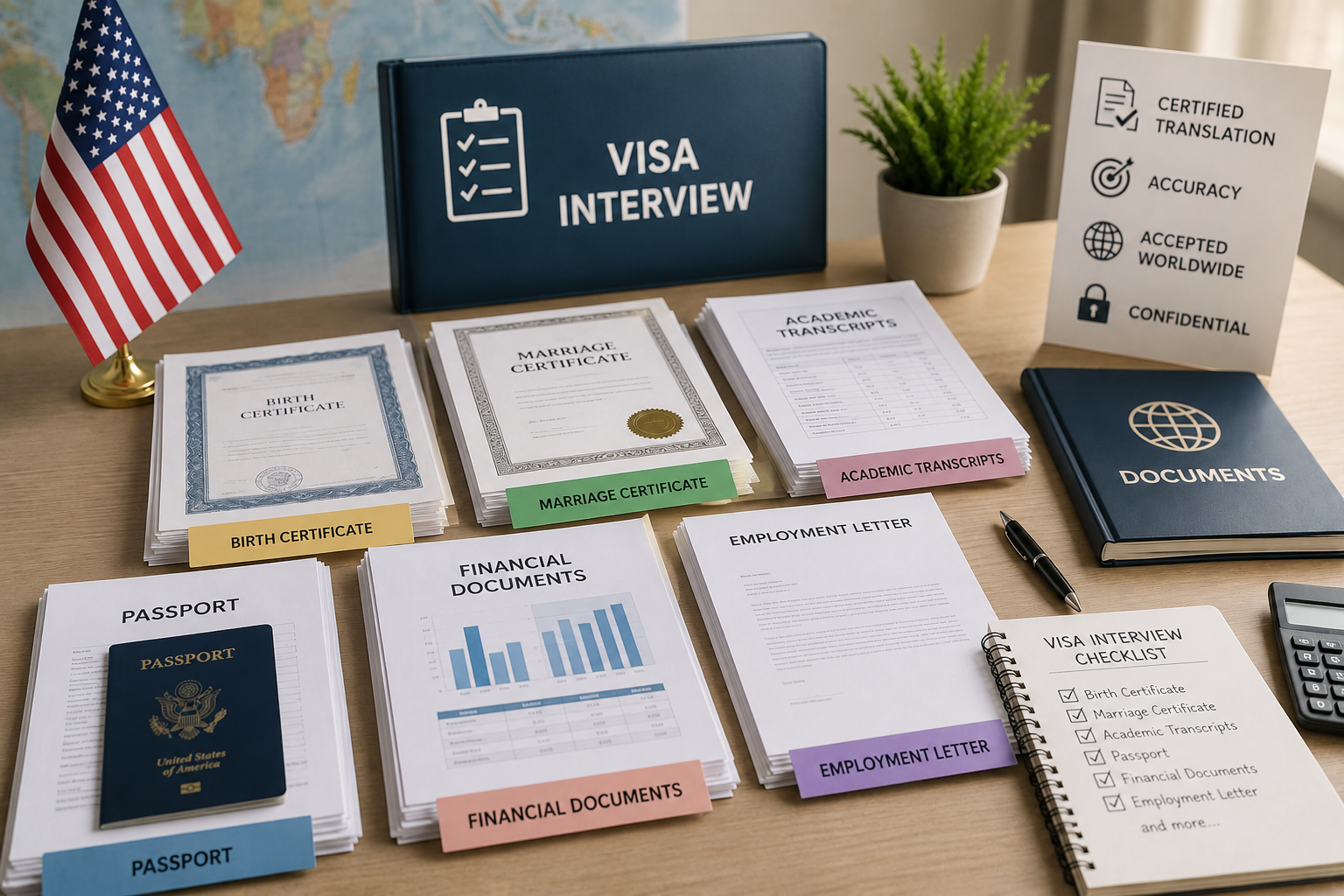
Before you can plan your timeline, you need to know which documents require translation. The exact list depends on the type of visa you are applying for and the country you are applying to, but the most common documents include:
Your birth certificate is almost always required. If it was issued in a language other than the one used by the consulate, you will need a certified translation.
Marriage or divorce certificates follow the same rule. Any change in your civil status needs to be documented and translated precisely.
Educational certificates and transcripts are often requested for student or work visas. These need to reflect your academic history with complete accuracy.
Employment records, bank statements, and financial documents are standard for most visa categories. They establish your ties to your home country and your ability to support yourself abroad.
Police clearance certificates are required for many long-term visa types. These tend to take the longest to obtain from local authorities, so factor that into your timeline before you even begin the translation step.
Property ownership documents or rental agreements may also be requested to prove your residency status.
The safest move is to contact the consulate directly or check their official website for the definitive list. Then gather every document before you translate documents for a visa interview so you can hand everything to your translator at once.
How Long Does It Actually Take to Translate Documents for a Visa Interview?
Most professional certified translations take between three and ten business days per document, depending on language complexity, document length, and the translator’s current workload.
If you have multiple documents that need translation, they can sometimes be processed simultaneously rather than one at a time. A reputable translation service will assign the right professionals to handle multiple files at once.
Here’s a rough timeline to keep in mind:
Simple one-page documents like birth certificates tend to take two to four business days.
Multi-page legal documents such as court records or employment contracts can take five to ten business days.
Rare language pairs, for example translating from a regional dialect into a less common European language, may take longer due to limited availability of qualified translators.
Notarization or apostille requirements, if the consulate requires them, can add another three to five business days on top of the translation itself.
When you add all of this up, it becomes very clear why waiting until two weeks before your visa interview is a risky move. Build your timeline backward from your interview date and count every business day carefully.
What Happens If You Wait Too Long to Translate Documents for a Visa Interview?
Waiting too long is one of the most common and costly mistakes applicants make. Here’s what can go wrong.
You may be forced to pay for rush or express translation services. These cost significantly more than standard rates, sometimes two to three times the regular price.
Even with rush services, there is no guarantee that the quality will meet the consulate’s requirements. Speed and accuracy don’t always go hand in hand, especially for complex legal language.
If a translated document contains an error and there is no time to correct it, you may have to request a postponement of your visa interview. In some countries, rescheduling can push your appointment back by several weeks or months.
In worst-case scenarios, submitting incomplete or incorrectly translated documentation can result in an outright rejection of your visa application. Recovering from a rejection takes time, effort, and often requires reapplying from scratch.
None of this is worth the risk. The cost of patience is minimal compared to the cost of a denied visa.
How to Choose the Right Service to Translate Documents for a Visa Interview
Not every translation service is equal in the eyes of immigration authorities. When you translate documents for a visa interview, the service you choose needs to meet specific standards.
Look for translators who offer certified translations. A certified translation includes a signed statement from the translator confirming that the translation is accurate and complete to the best of their professional knowledge.
Check whether the consulate requires translations from a government-approved or sworn translator. Some countries, particularly in Europe and Latin America, only accept translations from translators who are officially recognized by the national government.
Ask whether the service has experience with immigration documents specifically. Translating a marketing brochure is very different from translating a legal record for a government body. Experience in immigration contexts matters.
Look for turnaround guarantees and revision policies. A reputable service will offer a clear timeframe and will correct any errors without additional charges if the issue is on their end.
Read reviews from people who have used the service for visa-related translations. Positive outcomes from other applicants are one of the strongest indicators of quality and reliability.
At Global Doc Translations, we specialize in certified translations for visa and immigration applications across dozens of language pairs. Our team understands the exact standards required by consulates worldwide and we make sure every document we deliver is ready to submit with confidence.
Common Mistakes People Make When They Translate Documents for a Visa Interview
Knowing what not to do is just as important as knowing what to do. These are the errors we see most often.
Using an unqualified translator is the biggest mistake. Friends, family members, or bilingual colleagues cannot provide certified translations for official use, even if they speak both languages fluently. Consulates require professional certification.
Submitting translations without proofreading them is another frequent error. Even certified translators are human. Always review the translated document against the original before submitting.
Forgetting to include all pages is a surprisingly common oversight. If your original document has five pages, the translation must also account for all five pages. Missing pages will trigger a rejection.
Not checking the consulate’s formatting requirements is also a problem. Some consulates want documents in a specific order. Others require a particular font or page layout. A professional service that specializes in visa translations will already know these requirements.
Assuming all translations are the same regardless of destination country is a mistake that catches many applicants off guard. Requirements vary significantly from one country to another and even between different visa types within the same country.
Tips to Make It Easier to Translate Documents for a Visa Interview
Here are a few practical habits that will make the whole process smoother.
Start collecting your original documents the moment you decide to apply. Government offices can take weeks to issue certificates, especially if records are older or have been archived.
Make high quality copies or scans of every original document before handing anything to a translator. Keep both digital and physical backups.
Create a checklist of every document the consulate requires and tick each one off as it gets translated and certified. Don’t rely on memory.
Communicate your visa interview date clearly to your translation service so they can prioritize accordingly and flag any potential delays early.
Ask your translation provider whether notarization or apostille is included or whether you need to arrange that separately. Getting this wrong adds unnecessary delays.
Submit everything at least one week before your interview, not the day before. That buffer gives you time to address any last-minute issues without panic.
How Globaldoctranslations.com Makes It Easy to Translate Documents for a Visa Interview
At globaldoctranslations.com, we have helped thousands of applicants successfully translate documents for a visa interview across dozens of countries and language combinations.
Our certified translators work exclusively with immigration and legal documents. We know what consulates look for, what common rejection triggers are, and how to format translations so they clear review without complications.
We offer fast turnaround times without cutting corners on quality. Every translation goes through a two-stage review before it reaches you, so you never have to worry about submitting something that hasn’t been thoroughly checked.
We also offer guidance on notarization and apostille requirements if your destination country or specific visa type requires them.
Whether you need to translate one document or an entire package, we make the process straightforward, transparent, and stress-free.
Frequently Asked Questions
How far in advance should I translate documents for a visa interview?
Aim for at least four to six weeks before your interview date. This gives you enough time to handle corrections, certification, and any additional notarization that may be required without rushing.
Can I use an online translation tool to translate documents for a visa interview?
No. Online tools like Google Translate are not accepted by consulates or immigration authorities. Only certified human translations from qualified professionals are recognized for official use.
What makes a translation “certified” for a visa interview?
A certified translation includes a signed and dated statement from the translator confirming the accuracy and completeness of the translation. Some countries also require the translator to be government approved or sworn in officially.
What if my consulate rejects my translated documents?
Contact your translation provider immediately. A reputable service will correct errors quickly at no additional cost if the issue originates from their work. Make sure you understand the rejection reason before requesting revisions.
Is it possible to get same day translation for a visa interview?
Some services offer rush options, but same day delivery is rarely available for certified immigration documents and comes at a significant premium. More importantly, the quality risk increases when timelines are compressed. Avoid this situation by planning ahead.
Final Thoughts
The process to translate documents for a visa interview is straightforward when you give yourself enough time and work with the right professionals.
Start early. Gather your documents as soon as you schedule your interview. Choose a certified translation service with proven experience in immigration documentation. And submit everything with enough time to spare for corrections if needed.
The visa interview itself is the moment that matters. Don’t let paperwork problems get in the way of it.
If you’re ready to translate documents for a visa interview with a team that knows exactly what consulates require, visit globaldoctranslations.com today and get started.