If you’re going through the immigration process, you’ve likely already discovered just how detailed and demanding the paperwork can be. One of the most common — and most misunderstood — requirements is document translation for USCIS.
Getting this wrong doesn’t just cause frustration. It can delay your entire application by weeks or even months. A rejected translation means starting over, resubmitting forms, and in some cases, missing critical deadlines that affect your visa, green card, or naturalization status.
This guide walks you through everything you need to know about document translation for USCIS — what it means, what it requires, which documents need it, and how to make sure your translations are accepted without issue.
What Is Document Translation for USCIS?
The United States Citizenship and Immigration Services (USCIS) requires that any foreign-language document submitted with an immigration application must be accompanied by a complete English translation. This rule applies to every document written in a language other than English, without exception.
But document translation for USCIS doesn’t accept just any translation. The translation must be certified, meaning the translator or translation service must provide a signed statement declaring that the translation is accurate and complete, and that the translator is competent in both the source and target languages.
This is what distinguishes a certified translation from a general or machine translation. A standard Google Translate output — no matter how accurate — is never accepted by USCIS. Only translations accompanied by a proper certification statement qualify.
Why Does USCIS Require Certified Translation?
USCIS handles millions of applications each year across hundreds of nationalities and languages. Understanding what is required for document translation for USCIS is essential — certified translations exist to ensure that every document submitted can be fully understood, verified, and processed accurately by immigration officers.
Without a properly certified document translation for USCIS, officers cannot confirm that the information in your foreign document matches what you’ve stated in your application. Even a small discrepancy — a name spelled differently, a date formatted differently, or a detail that was paraphrased rather than translated verbatim — can trigger a Request for Evidence (RFE), which puts your entire application on hold.
Providing accurate document translation for USCIS protects the integrity of your application and demonstrates that you take the process seriously. Immigration officers are trained to spot improperly formatted or non-certified translations, and they will reject them without hesitation.
6 Critical Requirements for USCIS-Accepted Document Translation
1. The Translation Must Be Complete and Verbatim
USCIS requires that every element of the original document be translated — including headers, footers, stamps, seals, signatures, and any marginal notations. Nothing can be summarized, skipped, or paraphrased.
This is one of the most common mistakes people make when submitting a translation for immigration purposes. They assume that only the main body of the document matters. In reality, an official seal that says “Certified True Copy” or an issuing authority stamp at the bottom of a birth certificate must also be translated exactly as it appears.
At Global Doc Translations, every translation we provide captures all elements of the original document with full accuracy — including stamps, seals, and official notations that are easy to overlook.
2. The Certification Statement Must Be Included
A certified document translation for USCIS must include a written certification statement signed by the translator or an authorized representative of the translation company. This statement must confirm that the translator is competent in both languages and that the translation is accurate and complete to the best of their knowledge.
Without this statement, your document translation for USCIS is considered uncertified and will be rejected regardless of how accurate the actual translation is. The certification statement is not optional — it is a non-negotiable part of every compliant USCIS submission.
Global Doc Translations provides a complete certification statement with every document translation for USCIS, formatted to meet all federal immigration requirements.
3. Machine Translations Are Never Accepted
USCIS explicitly does not accept machine-generated translations — including translations produced by AI tools, Google Translate, or any other automated system — even if they are reviewed by a human afterward.
This rule exists because automated translations frequently misrender names, dates, legal terms, and official titles in ways that can create inconsistencies with your application. Immigration officers are trained to identify machine-generated language patterns, and submissions with these characteristics are flagged for rejection.
Your document translation for USCIS must be performed by a qualified human translator who is fluent in both the source language and English, and who understands the legal and official context of the document being translated.
4. The Translation Must Match the Original Document Format
A well-prepared USCIS translation should mirror the layout and structure of the original document as closely as possible. This helps immigration officers compare the two documents side by side and verify consistency.
If the original birth certificate has three sections — personal information, parental information, and official registration details — the translated version should reflect those same three sections in the same order.
At Global Doc Translations, our translators are trained to replicate the visual structure of the source document, ensuring that immigration officers can easily cross-reference the translation with the original during their review.
5. Every Foreign-Language Document Must Be Translated
One of the most frequently asked questions about document translation for USCIS is whether every single page needs to be translated — and the answer is yes.
If your supporting documentation includes a foreign-language birth certificate, marriage certificate, divorce decree, police clearance letter, academic transcript, court record, or any other official document, every page must have a corresponding certified English translation. Incomplete document translation for USCIS submissions — even a single untranslated page in an otherwise complete application — are enough to trigger an RFE or outright rejection.
Global Doc Translations offers comprehensive document translation for USCIS packages for full immigration files, ensuring that every document in your application is properly translated, certified, and ready for submission.
6. You Cannot Translate Your Own Documents
USCIS regulations state that applicants cannot translate their own documents, even if they are fully fluent in the source language. Similarly, a family member, friend, or colleague — no matter how qualified — cannot provide the translation for a USCIS submission.
The translation must be completed by a qualified, independent third party. This prevents conflicts of interest and ensures that the translated content is as objective and accurate as possible.
This rule catches many applicants off guard. Someone who speaks perfect Spanish, for instance, might assume they can simply translate their own birth certificate to save time and money. Under USCIS requirements, this is not permitted, and any application submitted with a self-prepared translation will be rejected.
Which Documents Most Commonly Require Translation for USCIS?
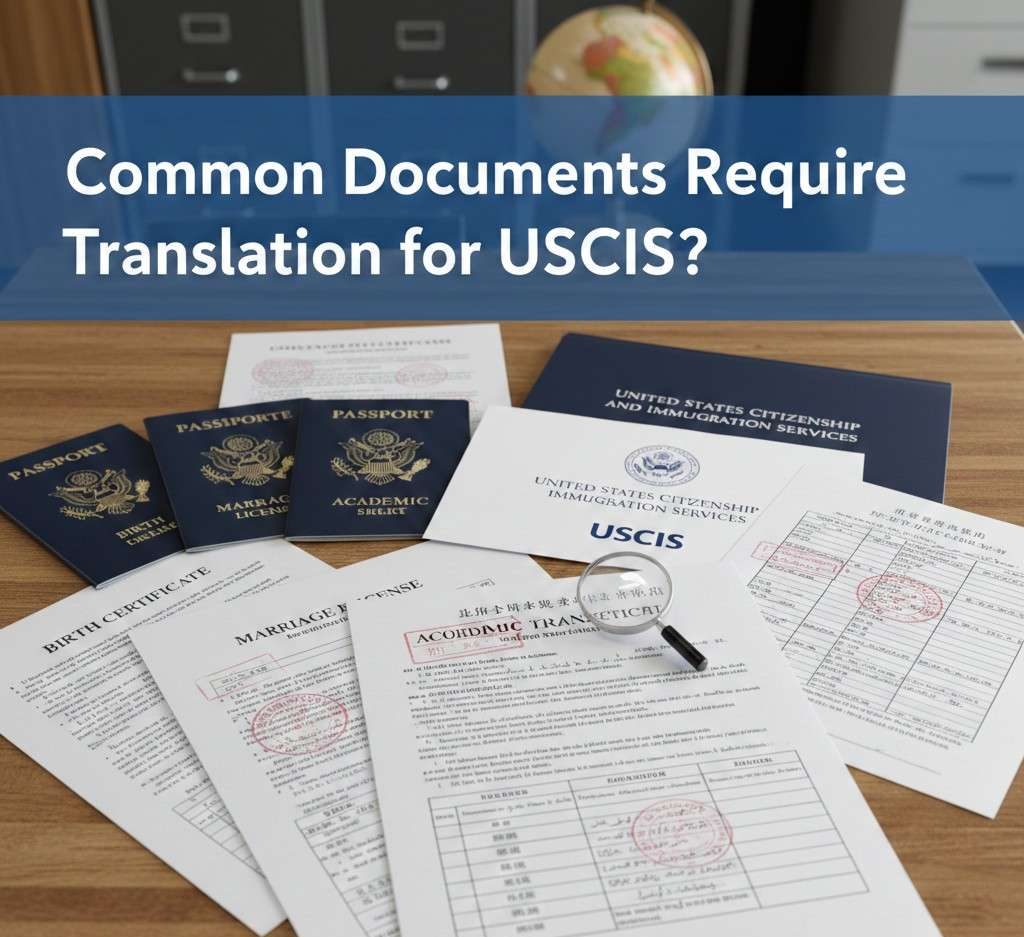
Nearly any official foreign-language document can be required as part of an immigration application. The most common documents that require certified translation for USCIS include birth certificates, marriage certificates, divorce decrees, death certificates, police clearance letters, court records, adoption documents, academic transcripts and diplomas, military service records, and national identity documents.
If you are applying for a green card, visa, naturalization, family-based petition, or asylum, there is a strong chance that at least one of these document types will be part of your submission.
Global Doc Translations specializes in certified immigration document translation across more than 100 languages, including Spanish, Arabic, French, Portuguese, Mandarin, Korean, Tagalog, Urdu, Vietnamese, and many more — all delivered with full USCIS-compliant certification.
How Long Does USCIS Document Translation Take?
Standard document translation for USCIS typically takes 24 to 48 hours for most single-page documents. Multi-page files or complex legal documents may take 2 to 5 business days depending on the language pair and document type.
Global Doc Translations also offers expedited translation services for clients working with urgent deadlines. Rush processing is available for same-day or next-day delivery in many cases, without compromising accuracy or certification quality.
How Much Does USCIS Certified Translation Cost?
The cost of document translation for USCIS varies based on the document type, language pair, length, and turnaround time required. Most single-document certified translations fall in the range of $40 to $100 per document. Multi-document immigration packages are typically priced at a reduced per-document rate.
Global Doc Translations offers transparent pricing with no hidden fees and a free quote for every project. You can upload your documents directly through the website and receive a quote within minutes.
Why Choose Global Doc Translations for USCIS Submissions?
Global Doc Translations is an ATA-affiliated professional translation service headquartered in Oregon, with locations in Lake Oswego, Hillsboro, and Vancouver, WA. We have extensive experience translating immigration documents for USCIS submissions, with a track record of first-submission acceptance for our clients.
Every translation we deliver is completed by a qualified human translator, reviewed for accuracy, and accompanied by a full certification statement that meets all USCIS requirements. We translate from and into over 100 languages, making us a reliable partner for clients across the Pacific Northwest and beyond.
Our clients include individuals navigating family-based immigration, visa applications, naturalization processes, asylum claims, and international adoption proceedings. Whether you need a single birth certificate translated or an entire immigration file prepared, we deliver certified, USCIS-compliant translations with speed and precision.
Final Thoughts
Document translation for USCIS is not something to cut corners on. A poorly formatted, uncertified, or self-prepared translation can derail an application you’ve spent months preparing. The six requirements covered in this guide are not suggestions — they are rules that USCIS enforces strictly, and even one missed requirement can send your application back to square one.
Working with a certified, experienced translation provider gives you the peace of mind that your immigration documents will be accepted the first time. At Global Doc Translations, that’s exactly what we’re here to deliver.