
Applying for a green card is one of the most significant steps a person can take on their immigration journey. It requires careful attention to every document, every deadline, and every requirement set by U.S. Citizenship and Immigration Services. One of the most commonly misunderstood requirements is the certified translation for green card applications. If you submit a document in a foreign language without a proper certified translation, USCIS will reject your application outright, potentially delaying your case by months.
This guide covers exactly which documents require a certified translation for green card filings, what USCIS expects from your translation provider, and how to avoid the mistakes that send thousands of applications back every year.
What Is a Certified Translation for Green Card Applications?
Before diving into the specific documents, it is important to understand what the term actually means. A certified translation for green card purposes is a translation accompanied by a signed statement from the translator or translation agency. That statement attests that the translation is accurate and complete to the best of the translator’s knowledge and ability.
USCIS does not require translators to be licensed or accredited by any government body. However, the translator must be competent in both the source and target languages. At Global Doc Translations, every certified translation for green card submissions includes a signed certificate of accuracy, the translator’s full name, signature, date, and contact information. This is the standard USCIS expects to see on every foreign language document in your application packet.
Why a Certified Translation for Green Card Is Non Negotiable
USCIS operates under a strict policy: every document submitted in a language other than English must be accompanied by a full English translation. That translation must be a certified translation for green card review to be accepted. There are no exceptions, no partial translations, and no summarized versions.
Failure to provide a proper certified translation for green card applications results in a Request for Evidence, commonly called an RFE. An RFE can add months to your case timeline and create additional costs. In some cases, if the RFE response is insufficient, USCIS may deny the application entirely.
Understanding this requirement from the start protects your timeline, your investment, and your future in the United States.
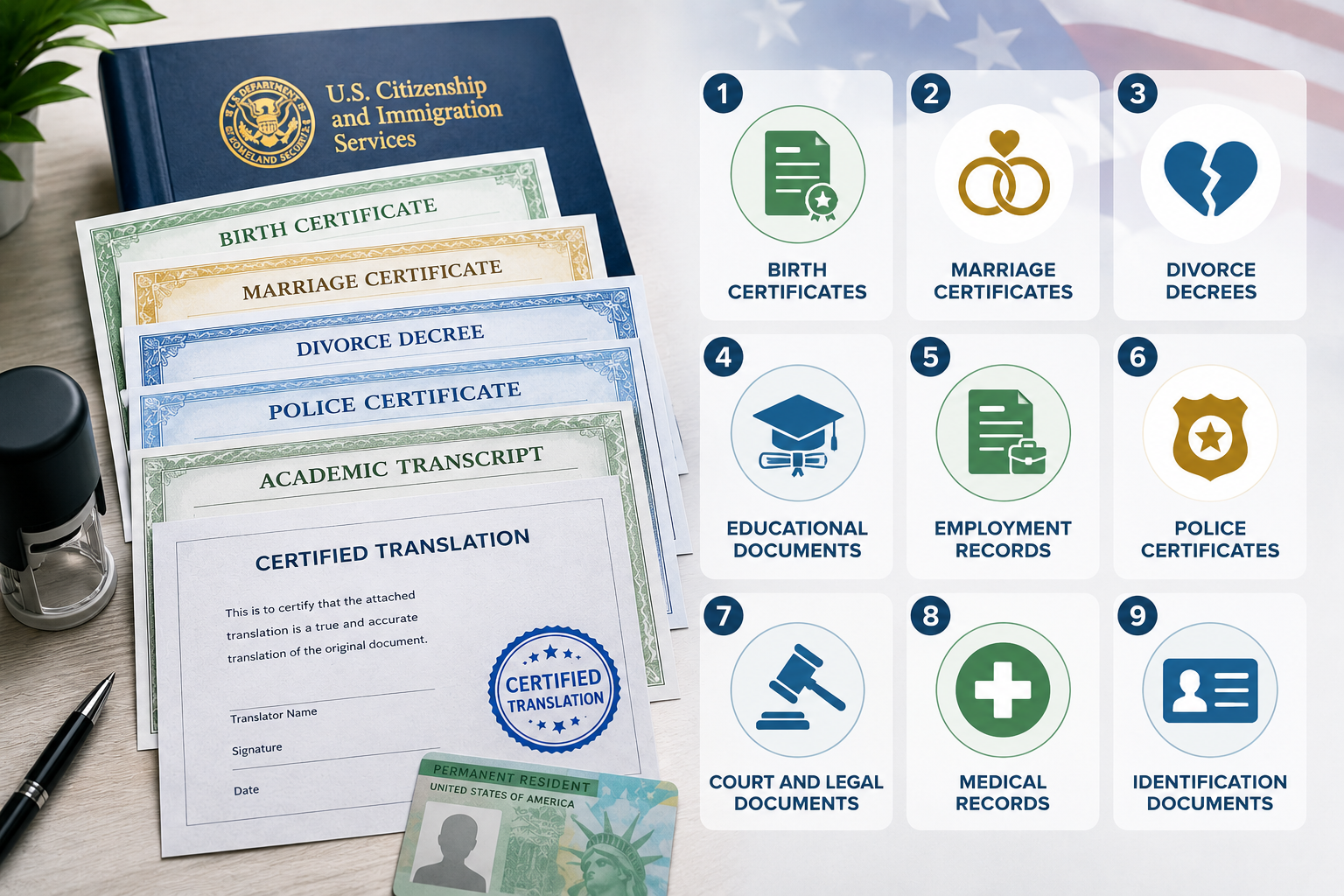
The 9 Document Categories That Require a Certified Translation for Green Card
1. Birth Certificates
Your birth certificate is the foundation of your identity in any immigration case. If you were born outside the United States and your birth certificate is in a foreign language, you must provide a certified translation for green card processing.
The translation must capture every field on the document, including your full name, date of birth, place of birth, parents’ names, and any official stamps or notations. Even decorative text around the borders of the certificate may need to be translated if it contains readable content.
Birth certificates from countries such as Mexico, China, India, the Philippines, South Korea, and Brazil are among the most commonly submitted documents that require a certified translation for green card cases. Regional variations in document formats make it essential to work with translators who are familiar with country specific certificate layouts.
2. Marriage Certificates
If you are applying for a green card based on marriage to a U.S. citizen or lawful permanent resident, your marriage certificate is a core document. Any marriage certificate issued in a foreign language must have a certified translation for green card filing purposes.
This applies to the original marriage certificate as well as any supporting civil registration records that accompany it. Some countries issue marriage booklets rather than single page certificates. Each page that contains text must be fully translated and certified.
If you were previously married and divorced, the divorce decree or annulment record from that prior marriage must also include a certified translation for green card review if the document is in a foreign language.
3. Divorce Decrees and Annulment Records
USCIS needs to confirm that any prior marriages have been legally dissolved before processing a marriage based green card. If your divorce decree or annulment record is in a language other than English, it requires a certified translation for green card submission.
This is an area where applicants frequently make errors. They may submit only the first page of a multi page divorce decree or provide a summary rather than a complete translation. USCIS requires the entire document to be translated, including case numbers, court names, judge signatures, and any conditions or orders contained within the ruling.
4. Passports and National Identity Documents
While your current valid passport is typically presented in its original form, any passport or national identity card that is referenced in your application and written in a foreign language must have a certified translation for green card processing. This is especially relevant when USCIS needs to verify prior entry dates, visa stamps, or identity details from older passports.
National identity cards, cedulas, and similar government issued identification documents from foreign countries must also be accompanied by a certified translation for green card cases when they are included in the filing packet.
5. Police Clearance Certificates and Criminal Records
One of the most sensitive document categories in the green card process is your criminal history record. USCIS conducts thorough background checks, and in many cases applicants must submit police clearance certificates from every country where they have lived for a significant period.
If any police clearance certificate is issued in a language other than English, it requires a certified translation for green card review. The stakes are especially high with these documents. An incomplete or inaccurate translation of a police clearance certificate can raise serious red flags with the reviewing officer, even when the underlying record is entirely clean.
Court records, sentencing documents, or arrest records from foreign jurisdictions that you are required to disclose must also each include a certified translation for green card compliance.
6. Military Records and Discharge Papers
Applicants who served in a foreign military may be required to submit records of that service as part of their green card application. These documents, which can include service records, discharge papers, rank certifications, and conduct evaluations, must be accompanied by a certified translation for green card filing if they are written in a language other than English.
The complexity of military document terminology makes this one of the more challenging translation categories. Military abbreviations, rank titles, and branch specific language can vary significantly across countries. A qualified translator with experience in military documentation is essential to producing an accurate certified translation for green card purposes in this category.
7. Academic Records and Diplomas
Academic records are not always required for green card applications, but they become necessary in several common scenarios. Employment based green card petitions often require proof of education to establish that the beneficiary meets the requirements of the position.
If your diplomas, transcripts, or professional certificates were issued by a foreign institution and are written in another language, each document must include a certified translation for green card or employment based immigration filings. Graduate degrees, professional certifications, and technical training records all fall under this requirement.
For applicants in the EB2 or EB3 preference categories, proper academic record translation can be the difference between approval and an RFE demanding clarification on qualifications.
8. Medical Records and Vaccination Histories
The green card medical examination, completed using Form I 693 by a USCIS designated civil surgeon, requires applicants to provide vaccination history. If your vaccination records were issued in a foreign country and are written in another language, they must include a certified translation for green card medical review.
In some cases, applicants also need to submit prior medical records related to conditions that may be relevant to the health related grounds of inadmissibility. Any such foreign language medical records must carry a certified translation for green card submission in order to be properly evaluated by the civil surgeon or USCIS.
Accuracy is especially critical with medical translations. Drug names, dosages, diagnoses, and treatment histories must be rendered precisely in English to avoid any misinterpretation that could complicate the medical review process.
9. Adoption Records and Legal Guardianship Documents
Applicants who were adopted or who have legal guardianship documentation from a foreign country may need to submit those records as part of establishing their identity or family relationships for the green card application.
Any adoption decree, guardianship order, or related legal document issued in a foreign language must be accompanied by a certified translation for green card processing. These documents often contain complex legal language and references to specific provisions of foreign law. A skilled legal translator who understands both the linguistic and legal dimensions of these records is essential to producing a reliable certified translation for green card cases involving adoption or guardianship.
What Must a Certified Translation for Green Card Include?
A compliant certified translation for green card applications must meet specific formatting standards. While USCIS does not publish a rigid template, the following elements are universally expected:
Complete and accurate translation of the full document. Every word, number, stamp, seal description, and official notation must appear in the English version. Partial translations are not accepted.
A certificate of accuracy. This is a signed statement from the translator or translation agency declaring that the translation is true and accurate to the best of their ability. It must include the translator’s full name, signature, date of certification, and contact details.
Consistent formatting. The layout of the translated document should mirror the original as closely as possible, making it easy for the USCIS officer to compare the two side by side.
At Global Doc Translations, every certified translation for green card submission is reviewed by a senior translator before delivery to ensure it meets USCIS standards in full.
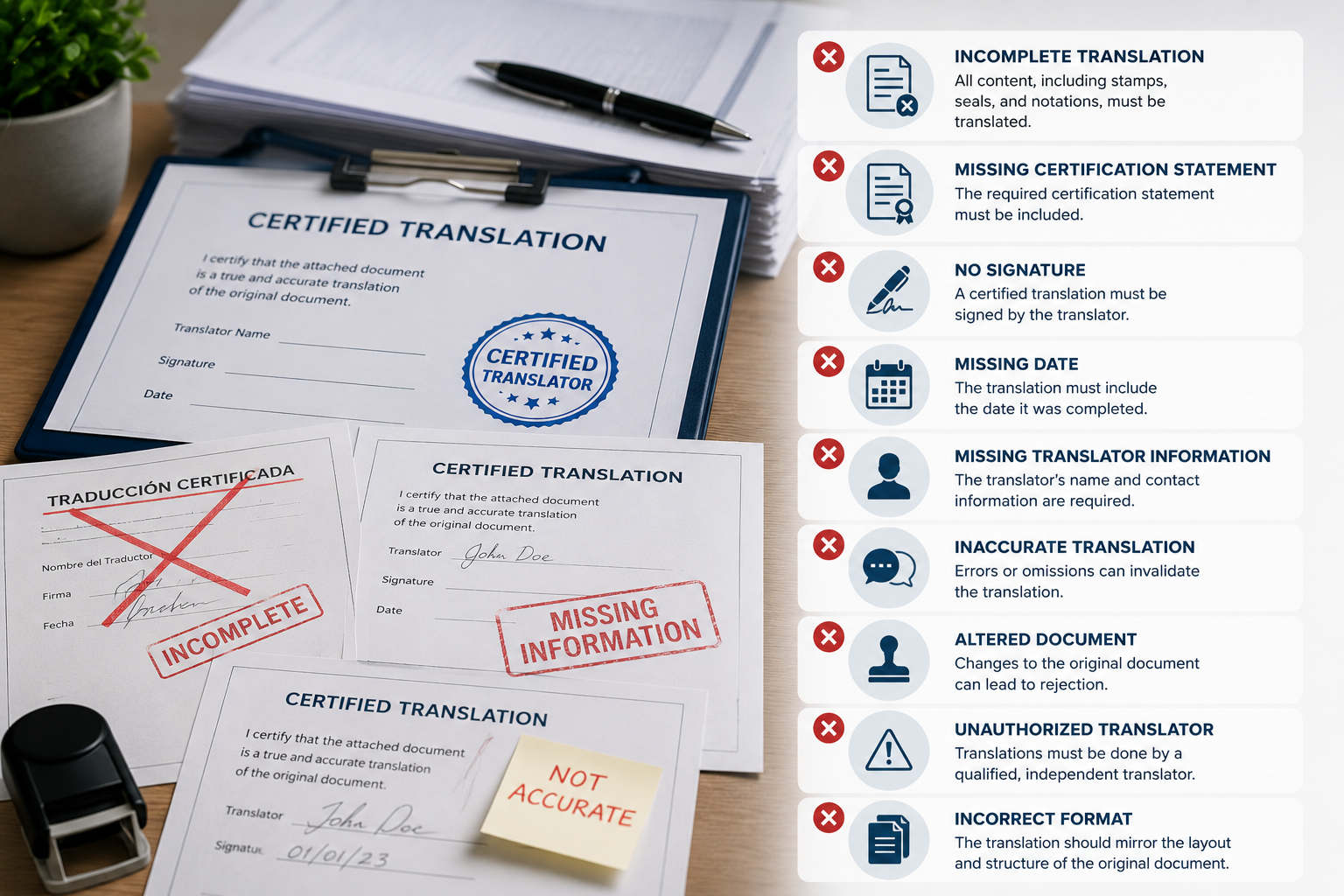
Common Mistakes That Invalidate a Certified Translation for Green Card
Even applicants who understand the requirement often make avoidable errors. Here are the most common issues that can invalidate a certified translation for green card filing:
Using a bilingual friend or family member. USCIS requires that the certifying translator confirm they are competent in both languages. A friend or family member cannot certify their own translation in a manner USCIS will accept for official review.
Submitting a machine translation without certification. Tools like Google Translate produce uncertified, unverified output. A machine generated translation submitted without a professional certificate of accuracy is not a valid certified translation for green card purposes.
Translating only the visible text and ignoring stamps. Official stamps, seals, and marginal notations are part of the document. Leaving them out means the translation is incomplete, which can trigger an RFE.
Using a translation agency that does not specialize in immigration documents. Immigration documents carry specific terminology and formatting conventions. A general translation service without immigration experience may produce technically accurate language but miss the structural and contextual standards that make a certified translation for green card submissions compliant.
Failing to include the translator’s contact information. USCIS reserves the right to contact the translation provider to verify the certification. A missing phone number or address can raise questions about the document’s authenticity.
How to Choose the Right Provider for Your Certified Translation for Green Card
Not all translation services are created equal, and the certified translation for green card process is not an area where cutting corners pays off. Here is what to look for when selecting a provider:
Specialization in USCIS and immigration documents. Choose a provider that regularly handles green card, visa, and citizenship related documents. They will be familiar with USCIS expectations and formatting requirements.
Native level linguists in the source language. The quality of a certified translation for green card is only as good as the translator’s mastery of the original language. Native speakers with formal training in legal or civil document translation produce the most reliable results.
Turnaround time that fits your filing schedule. Immigration deadlines are real and consequential. A reliable translation provider should be able to confirm realistic delivery timelines and offer expedited options when needed.
Clear certification documentation. Before submitting any certified translation for green card applications, verify that the certificate of accuracy includes all required elements: translator name, signature, date, and contact information.
Transparent pricing with no hidden fees. Document translation for immigration purposes should come with clear per page or per document pricing. Surprise charges after submission create unnecessary stress during an already demanding process.
Global Doc Translations provides certified translation for green card applications across all major languages, with fast turnaround, USCIS compliant formatting, and transparent pricing on every order.
How Long Does a Certified Translation for Green Card Take?
Turnaround time for a certified translation for green card document depends on the length of the document, the language pair involved, and the complexity of the content. Standard civil documents such as birth certificates and marriage certificates are typically completed within one to two business days.
More complex documents such as police clearance certificates with dense legal language, multi page divorce decrees, or medical records with technical terminology may require two to four business days for a thorough and accurate certified translation for green card submission.
Expedited options are often available for applicants who are working against tight filing deadlines. When requesting expedited service, always confirm that speed will not come at the cost of accuracy or certification compliance.
Does USCIS Ever Waive the Certified Translation for Green Card Requirement?
The short answer is no. USCIS does not waive the certified translation for green card requirement under any standard circumstances. The agency’s regulations are clear: all foreign language documents must be accompanied by a complete English translation and a certification of accuracy.
There is no provision for submitting a document in its original foreign language with a promise to translate later. There is no provision for submitting a bilingual document and asking the officer to rely on the English portions only. The certified translation for green card requirement applies universally across all application types and all document categories.
If you are preparing a green card application and have documents in a foreign language, begin the translation process as early as possible to avoid delays.
Final Thoughts: Getting Your Certified Translation for Green Card Right the First Time
The green card application process is long, detailed, and unforgiving of errors. A missing certification, an incomplete translation, or a document submitted without the required certified translation for green card review can set your case back significantly.
The nine document categories outlined in this guide cover the vast majority of situations that applicants encounter. Birth certificates, marriage certificates, divorce decrees, passports, police clearance certificates, military records, academic records, medical records, and adoption documents all require a certified translation for green card applications when they are issued in a foreign language.
Working with a professional translation provider that understands USCIS standards from the start is the single most effective way to protect your application from avoidable rejections.
Global Doc Translations specializes in certified translation for green card filings across all major world languages. Our translators are native speakers with deep experience in immigration document requirements, and every translation we deliver includes a USCIS compliant certificate of accuracy. Visit globaldoctranslations.com to place your order or request a quote today.